
Parsons School of Design | Spring 2025 | Design Studies Final
Willkommen! Bienvenue! Welcome to Cabaret! Since its Broadway debut in 1966, Cabaret has captivated audiences with its subversive plot and groundbreaking storytelling. Set in Berlin in the final years of the Weimar Republic, the musical portrays a society on the brink of collapse, using the Kit Kat Club as both a space of liberation and a harbinger of impending authoritarianism. As fascism rises outside its doors, the club’s revelers dance in a haze of sex, cynicism, and cabaret. The musical, based on Christopher Isherwood’s semi-autobiographical Goodbye to Berlin, has endured for decades, thanks in no small part to the power of its visual storytelling. Costume design has played a crucial role in shaping audience interpretations of the show’s themes, characters, and historical context. This paper argues that the evolution of costume design in Cabaret across its major productions reflects shifting global political climates and evolving cultural attitudes toward gender, sexuality, and authoritarianism.Applying semiotic analysis, gender performativity, and spectacle theory, it is regarded that the costume design in Cabaret serves as more than mere aesthetic; it is a politically engaged medium. Through close examination of key productions, the 1966 Broadway debut, the 1972 film adaptation, the 1998 and 2014 Studio 54 revivals, and the 2021 West End revival, it is possible to draw a direct timeline and illustrate how theatrical fashion becomes a lens through which contemporary anxieties are both expressed and critiqued.

Cabaret. Directed by Bob Fosse. Still image featuring Liza Minnelli. Allied Artists, 1972.
Historical Context: Weimar Berlin and the Aesthetic of Decadence
Weimar Berlin was a cultural epicenter defined by artistic experimentation, sexual liberation, and political instability. The Kit Kat Club embodies this era’s indulgence and its fragility in the face of rising fascism. The original 1966 Broadway production, designed by Patricia Zipprodt, introduced an aesthetic that subtly coded queerness and decadence while maintaining an undercurrent of Cold War-era caution (Zipprodt, Patricia. Costume Designs for Cabaret (1966). Broadway Archive.). The production’s visual language framed Weimar Berlin as a place of both allure and danger, setting the stage for subsequent revivals to reinterpret its themes in light of contemporary political concerns.On the one hand, it was a haven for avant-garde experimentation, queer expression, and political liberalism. On the other, it teetered on the edge of economic collapse and social unrest. The Kit Kat Club in Cabaret embodies this duality: an oasis of escapist pleasure and a warning sign of moral decline.

Unknown cabaret performers, Weimar Berlin, ca. 1920s, photograph, photographer unknown.
In costume terms, this historical period was marked by androgynous fashion, burlesque performance wear, and an embrace of gender subversion. These elements provided rich material for costume designers seeking to recreate or reinterpret the Weimar aesthetic for different political moments. According to costume scholar Rebecca Rovit, costuming in American musical theatre often functions as a form of national self-reflection (Rebecca Rovit, “Dressing the Nation: Costume and Identity in American Musical Theater,” Theatre Journal 61, no. 2 (2009): 215–233.). The fluctuating treatment of Cabaret’s visual language demonstrates this on an international scale.

Façade of Tanz-Kabarett, Berlin. Ca. 1920s. Photograph. Photographer unknown.
The Cold War backdrop lent additional tension to these costuming choices. The spectacle of Berlin as a place of sin and decay became a cautionary tale. Zipprodt’s subtlety in costume design both protected the production from censorship and invited deeper readings from those attuned to subtext. Her work established a visual template that would be radicalized in later revivals.

Joel Grey and dancers in the 1966 Broadway production of Cabaret, 1966, photograph, photographer unknown.
1972 Film Adaptation: Sexual Liberation and Countercultural Influences
Bob Fosse’s Cabaret (1972) amplified the sexualization of its characters, reflecting the countercultural movements of the late 1960s and early 1970s. Charlotte Flemming’s costume designs for the film heightened the contrast between the decadent world of the Kit Kat Club and the growing Nazi presence outside (Fosse, Bob, dir. Cabaret. 1972.). The Emcee’s outfits grew increasingly flamboyant, his makeup bolder, his gestures more provocative.

Joel Grey and Liza Minnelli in the 1972 film Cabaret. 1972. Photograph. Warner Bros. Pictures.
These choices paralleled the post-1960s countercultural movements that championed sexual liberation and challenged traditional morality. Liza Minnelli as Sally Bowles also sported a new signature look, complete with green nail polish and slinky dresses, was not just fashion-forward but symbolically defiant. She embodied the feminist ethos of the time, while also reflecting the vulnerability and volatility of living outside societal norms.

Cabaret (film poster). 1972. Warner Bros. Pictures.
The film used costuming to draw starker contrasts between the Kit Kat Club and the encroaching Nazi menace. The visual world of the club became a metaphorical last gasp of freedom before the descent into fascism. The film advanced costume design as a critical storytelling tool.
1998 Broadway Revival: The AIDS Crisis and Androgynous Aesthetics
The 1998 Broadway revival, directed by Sam Mendes, introduced darker and more androgynous costuming, designed by William Ivey Long. Alan Cumming’s Emcee, clad in suspenders and heavy makeup, blurred gender lines more explicitly than previous iterations (Long, William Ivey. Costume Design for Cabaret (1998). Broadway Production Archive.). The production’s aesthetic responded to the lingering trauma of the AIDS crisis, positioning Cabaret as a meditation on queer existence in the face of social and political neglect. Mendes’ revival also emphasized the creeping threat of fascism, underscoring the parallels between Weimar Berlin and contemporary anxieties about authoritarian resurgence.

Cabaret Playbill cover, 1998 Broadway revival, Playbill Inc.
This visual turn toward androgyny and erotic danger in the costuming served multiple purposes. Now, Broadway’s aesthetic codes began to loosen and opened space for more creative freedom and exploration of gender and sensuality. It was a response to the trauma of AIDS and the stigmatization of queer bodies, but it also reflected 1990s cultural fascinations with gender fluidity and body politics. The AIDs crisis of the time shaped so much of the queer community and the trends that were picked up by their circles, and, in turn, picked up by the mainstream in following years. The production was staged inside a transformed nightclub space, Studio 54, immersing the audience in an experiential environment that echoed Weimar cabaret culture.

Alan Cumming in the 1998 Broadway revival of Cabaret, photograph, photographer unknown.
Studio 54 itself was a legend in the nightlife space. It was a place for total liberation. Perhaps, it could even be argued to be the modernist iteration of the infamous fictional Kit Kat Club. It was frequented by personalities like Andy Warhol and Michael Jackson, known for throwing the most extravagant parties. Despite its exclusivity, Studio 54 was known for its artistic, subversive and rebellious nature.
Long’s designs made queer subtext fully text. The Emcee’s clothing choices—sometimes exposing, sometimes concealing—became acts of resistance. Natasha Richardson brought a new life to the female protagonist as well, with Sally Bowles’ wardrobe becoming equally telling, shifting between performative glamour and emotional vulnerability. At the time, women—nurses—were the ones who stepped into the light to help queer patients of AIDs, while most male doctors cowered away in ignorance. Bowles represents this resistance. The revival’s aesthetic suggested that the line between performance and survival had become dangerously thin.
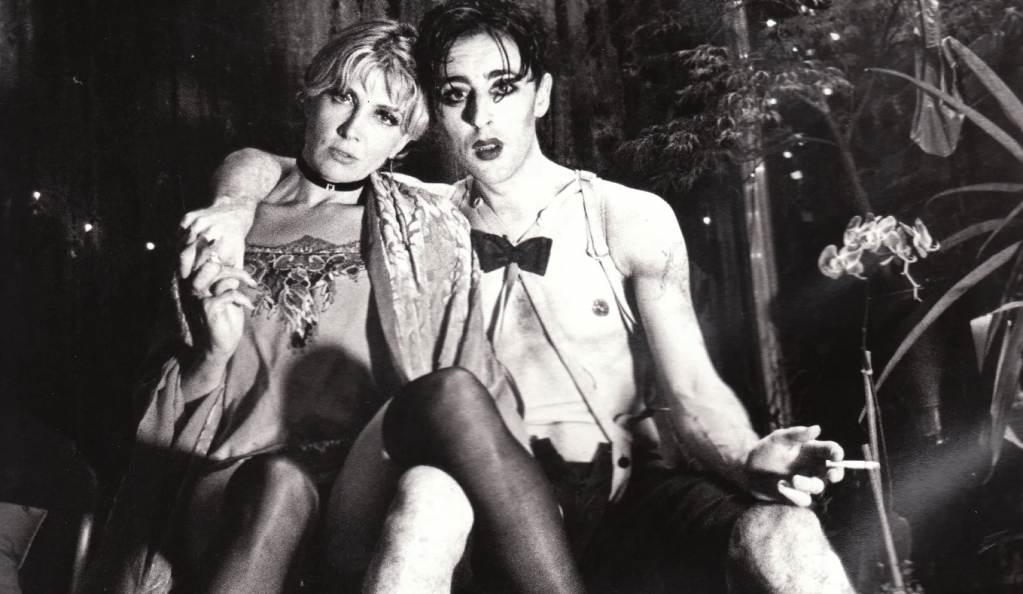
Alan Cumming and Natasha Richardson in the 1998 Broadway revival of Cabaret, photograph, photographer unknown.
2014 Studio 54 Revival: Populism and Hypersexualization
Revisiting the Mendes production, the 2014 Studio 54 revival further emphasized the hypersexualized aspects of Cabaret, reflecting the increasingly commercialized and voyeuristic nature of contemporary entertainment. The costuming choices leaned into spectacle, with Sally Bowles’ wardrobe exuding a more overtly performative sexuality, paralleling the rise of populism and the commodification of rebellion in the 21st century (Mendes, Sam, dir. Cabaret. Studio 54 Revival, 1998 & 2014.).
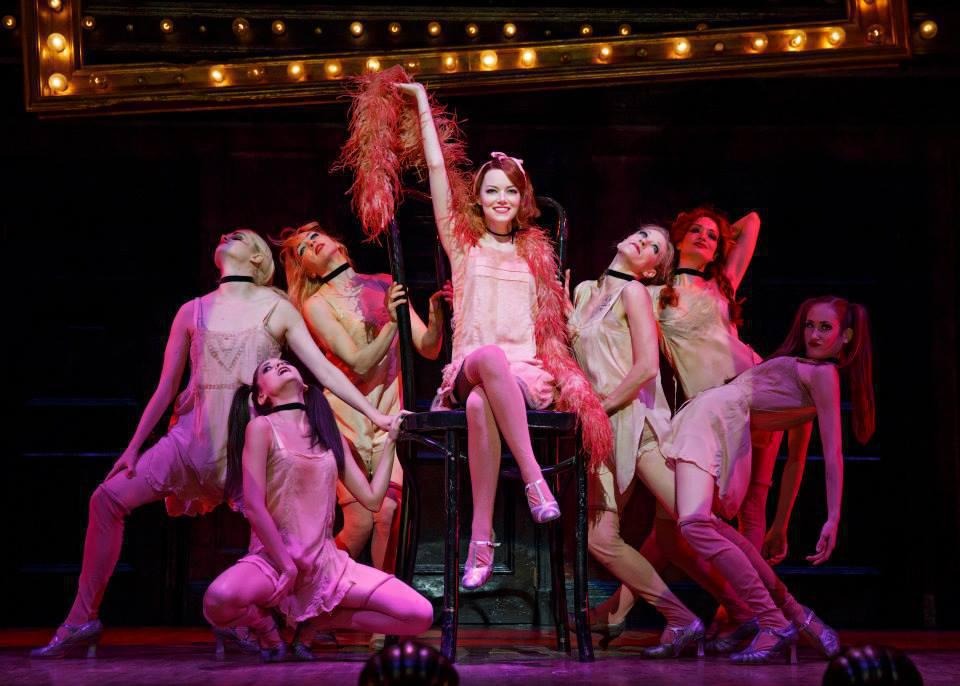
Emma Stone as Sally Bowles and dancers in the 2014 Broadway revival of Cabaret, photograph, photographer unknown.
Sally Bowles (played by Michelle Williams and later Emma Stone) was costumed to reflect a self-aware performance of sexuality, suggesting rebellion packaged for mass consumption. Her image was less about authenticity and more about selling the illusion of subversion. The Emcee, still a symbol of queer defiance, became an even more grotesque figure: part ringmaster, part prophet of doom.

Michelle Williams as Sally Bowles and dancers in the 2014 Broadway revival of Cabaret, photograph, photographer unknown.
These costuming choices echoed contemporary anxieties about populism and cultural numbness. In a world where rebellion is commodified, Cabaret asked whether dissent had become just another form of entertainment. If the descent into facism and overarching message of the musical had been commodified and re-packaged into wacky makeup and trendy, interesting costuming. In part due to the nature of mainstream celebrities like Williams and Stone taking on one of the protagonist roles of the story, and in part to the costuming having become almost palatable as fashion evolved outside the world of Broadway stages; had we forgotten to pay attention to the plot? In the world of people driven by their senses, no viewer is immune to propaganda, and that is the power of good design.

Alan Cumming as Emcee in the 2014 Broadway revival of Cabaret, photograph, photographer unknown.
2021 West End Revival: Identity Politics, Punk Influences, and Warnings Against Authoritarianism
The 2021 West End production incorporated punk aesthetics and contemporary gender-fluid costuming to reflect modern identity politics. Tom Scutt’s designs rejected polished theatricality in favor of a raw, transgressive look, aligning with contemporary discussions of queerness and resistance (Scutt, Tom. Cabaret (2021 West End Revival). Costume Design Archive.). This revival highlighted the urgent warnings embedded in Cabaret, drawing explicit parallels between Weimar Berlin and the global rise of authoritarianism in the 2020s.

Eddie Redmayne as Emcee and Tom Scutt’s costume sketch for the 2021 Broadway revival of Cabaret, photograph, photographer unknown.
Costumes in this production were gender-fluid and often deconstructed, reflecting the aesthetics of today’s drag and queer performance scenes. Sally Bowles, played by Jessie Buckley, donned thrifted-looking outfits and smudged makeup, leaning into an anti-glamour ethos that resonated with younger, politically conscious audiences. These choices aligned with the rise of intersectional feminism, queer visibility, and post-pandemic societal disillusionment. This is a contrast to the previous iterations of Sally Bowles, who was put on a pedestal by characters and audiences alike. Scutt’s costuming transformed the character. It made her raw, real, gritty, and, in essence, a reflection of the modern women in the face of our current political climate.

Jessie Buckley as Sally Bowles and Tom Scutt’s costume sketch for the 2021 Broadway revival of Cabaret, photograph, photographer unknown.
Importantly, this revival did not shy away from overt political commentary. Costumes served to heighten the sense of impending collapse and critique contemporary authoritarian trends globally: from Brexit to Trumpism to Hungary’s crackdown on LGBTQ+ rights. The Emcee’s look became a kind of living monument to resistance, decay, and the corruption of exposure to hatred and bigotry.

Eddie Redmayne as Emcee and Tom Scutt’s costume sketch for the 2021 Broadway revival of Cabaret, photograph, photographer unknown.
Theoretical Application: Costume as Political Signifier
Using Roland Barthes’ semiotic theory, costume design in Cabaret can be analyzed as a system of signs that communicate political meanings (Barthes, Roland. Mythologies. Translated by Annette Lavers. Hill and Wang, 1972.). The Emcee’s evolving wardrobe, for example, signifies shifting societal anxieties: from Cold War repression to contemporary struggles for gender and sexual identity. Barthes’ framework reveals how visual codes operate in performance to produce layers of meaning beyond the narrative text.
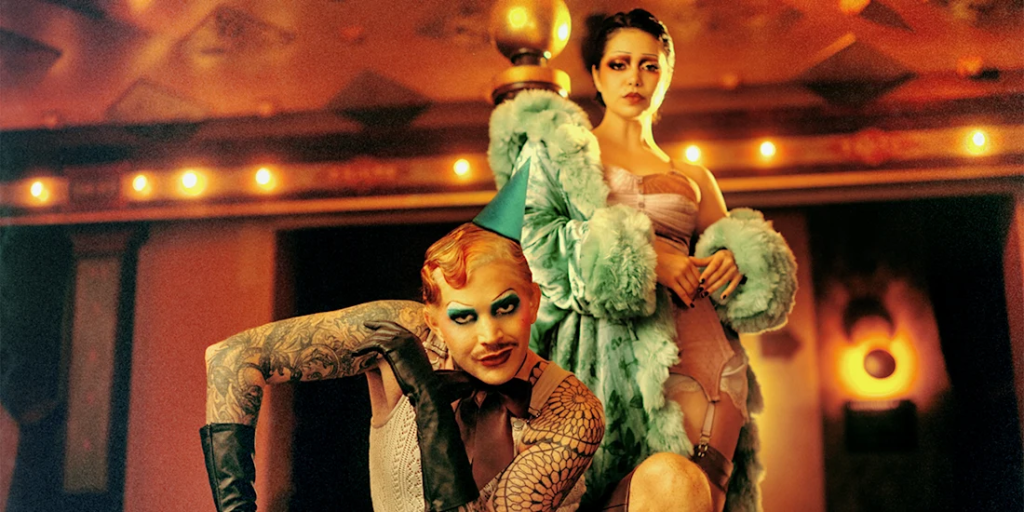
Auli’i Cravalho as Sally Bowles and Adam Lambert as Emcee in the 2025 Broadway revival of Cabaret, photograph, photographer unknown.
Judith Butler’s concept of gender performativity further elucidates how Cabaret‘s costuming constructs and deconstructs gender norms (Butler, Judith. Gender Trouble: Feminism and the Subversion of Identity. Routledge, 1990.). Butler’s theory demonstrates how the Emcee and Sally Bowles embody gender as performance, complicating traditional binaries and exposing their social construction. Particularly in the 1998 and 2021 revivals, costuming foregrounds the fluidity of gender identity in ways that resonate with contemporary audiences. The 1998 version was a response to the mainstream viewing queer media as a threat, and this same unfortunate history repeating itself in the 2020’s, as conservatism begins to take over and implement purity culture; Cabaret is needed more than ever.
Finally, Guy Debord’s spectacle theory situates Cabaret‘s visual aesthetic within the broader discourse of entertainment as both a form of escapism and a critique of political complacency (Debord, Guy. The Society of the Spectacle. Zone Books, 1994.). In each production, the Kit Kat Club’s visual excess serves not only to enthrall audiences but also to underscore the dangers of distraction in the face of political collapse.
Further Costume Symbolism Analysis
Beyond the central figures of the Emcee and Sally Bowles, Cabaret’s ensemble costumes play a vital role in shaping the political tone of each production. The Kit Kat Club dancers, often relegated to background, actually mirror the broader social conditions at play. In the 1998 and 2021 revivals, for instance, dancers were often costumed in garments that blurred gender, age, and class distinctions, reinforcing the club as a liminal space where social rules dissolved. This invites the audience to question whether the performativity of gender matters in the face of the threat of societal collapse.
Fräulein Schneider and Herr Schultz’s more conservative costumes represent a vanishing middle class, caught in the ideological and economic crossfire. As the play progresses, their clothing becomes more muted, their physical postures stiffer, an embodiment of shrinking hope.
Even Nazi characters are deliberately styled to signal shifts in power. In the Mendes revivals, Ernst Ludwig’s subtle costume changes, from jovial businessman to uniformed ideologue, visually communicate the stealthy normalization of fascism. These micro-narratives embedded in costume design enhance the audience’s understanding of how totalitarianism infiltrates everyday life. Small crumbs in his costuming—such as the cut and stitching—change throughout the progression of the plot, to subtly signify his descent into total bigotry.
Additional Context on Theatrical Trends
The evolution of Cabaret‘s costume design mirrors broader trends in politically charged musicals. Productions like Hair (1968) and Rent (1996) similarly employed costume to signal countercultural rebellion and marginalized identities. Further, other musicals, such as Spring Awakening, Hedwig and the Angry Inch, and Hamilton, have also used costume design to reflect and influence political discourse. What distinguishes Cabaret, however, is its recursive engagement with history. How it remains utterly current, the threat of facism and purity culture resurfacing as people fail to learn from our history and need to be reminded through entertainment. Each revival is both a retelling and a reinterpretation, a kind of visual historiography.
Technological advancements in theater—such as improved stage lighting and fabric technologies—also influenced costume designs in later productions. These innovations allowed for more subtle textures and color shifts that could dynamically respond to mood changes in the narrative, further enriching the semiotic landscape of the performance. The advent of social media and digital archiving has made every visual choice part of the broader cultural conversation, adding layers of accountability and interpretation.

Jessie Buckley as Sally Bowles and Eddie Redmayne as Emcee in the 2021 Broadway revival of Cabaret, photograph, photographer unknown.
Extended Discussion of Contemporary Parallels
Audience reception of the 2021 revival reveals deep anxieties about the fragility of democratic institutions in the 2020s. Reviews noted the raw, urgent energy of the production, emphasizing its relevance to contemporary political landscapes fraught with rising nationalism and authoritarian governance (Wolf, Stacy. Changed for Good: A Feminist History of the Broadway Musical. Oxford University Press, 2011.)
Using Roland Barthes’ semiotic theory, we can read Cabaret‘s costume designs as systems of signs (Roland Barthes, Mythologies, trans. Annette Lavers (New York: Hill and Wang, 1972).). The Emcee’s makeup, suspenders, and gestures signify deviance, surveillance, freedom, and collapse. All depending on the cultural context in which the production is staged. Judith Butler’s theory of gender performativity helps us understand how these costumes don’t just represent gender; they do gender (Judith Butler, Gender Trouble: Feminism and the Subversion of Identity (New York: Routledge, 1990).). The audience watches characters literally dress into their identities, making queerness visible as both danger and delight.

Fräulein Schneider (Kelly Ground) and Herr Schultz (Richard Farrell) embrace in Center Repertory Company’s Cabaret, photographed by Kevin Berne, Center Repertory Company.
Guy Debord’s concept of the spectacle is equally applicable (Guy Debord, The Society of the Spectacle (New York: Zone Books, 1994).). The cabaret is a spectacle that numbs its viewers while secretly indicting them. Costume becomes part of the machinery of this spectacle, both hiding and revealing truths about complicity, resistance, and denial.
Cabaret’s visual and thematic choices continue to inspire modern theater and fashion. Designers such as Vivienne Westwood have drawn from punk aesthetics similar to those seen in the 2021 revival, demonstrating how Cabaret‘s costuming has entered broader cultural lexicons of rebellion and resistance.
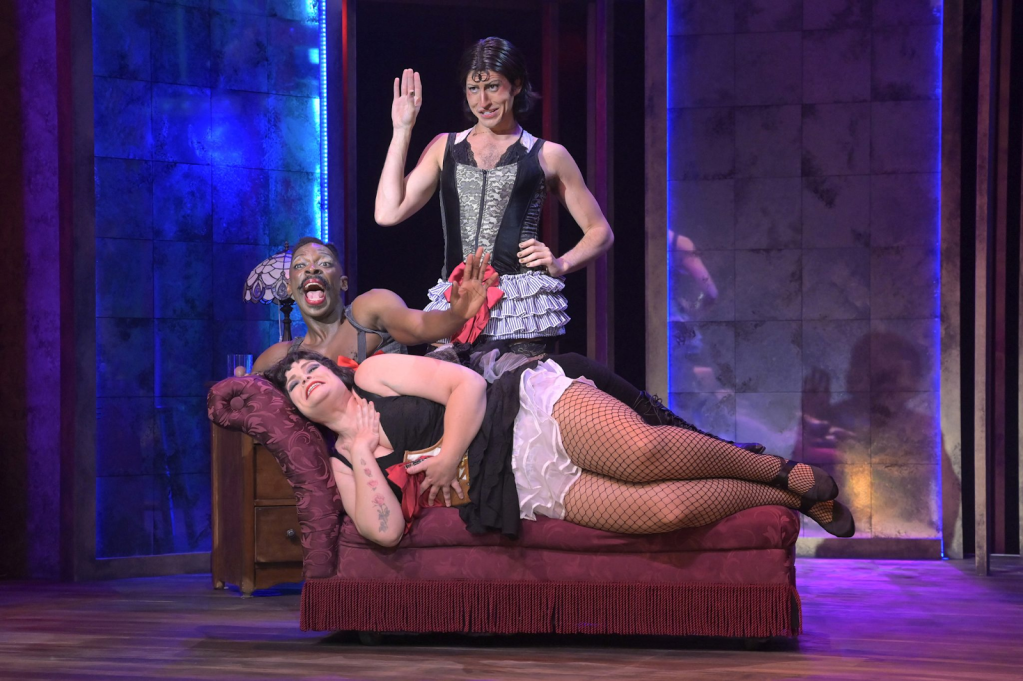
Kit Kat Club dancers Elizabeth Curtis, Rotimi Agbabiaka, and Landan Berlof in Cabaret, photograph by Kevin Berne.
Conclusion
The evolution of Cabaret‘s costume design is a testament to theater’s capacity to engage with political discourse. Each major production reflects the concerns of its era, using aesthetic shifts to comment on contemporary struggles with authoritarianism, gender identity, and cultural memory. Through the lenses of semiotics, gender performativity, and spectacle theory, this paper underscores the role of theatrical design in shaping historical narratives and audience perceptions. Ultimately, Cabaret’s enduring relevance lies in its ability to reframe history through fashion, making the past a mirror for the present.


 Cat Jacobi
Leave a comment